
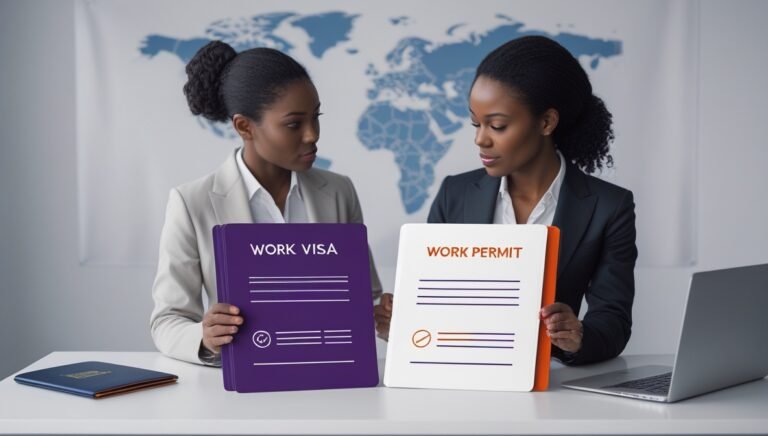
Work Visa vs. Work Permit: What’s the Difference?
If you are planning to work in another country, you may have encountered the terms work visa and work permit. They are often used interchangeably in everyday conversations, job advertisements, and recruitment discussions. However, they do not always mean the same thing.
Understanding the difference between a work visa and a work permit can help you identify the documents you need, avoid misunderstandings with employers, and prepare for the correct immigration process.
In some countries, a work visa gives a foreign national permission to enter and work under specific conditions. In others, a work permit is a separate document or authorization that allows someone to undertake employment. Some immigration systems use different terminology altogether.
Also Read



The most important rule is to check the official immigration requirements of your destination country. A document that authorizes employment in one country may have a different name or function in another.
This guide explains the general differences, provides examples from several countries, and shows you what to check before accepting an overseas job.
What Is a Work Visa?
A work visa is a type of immigration permission that allows an eligible foreign national to enter or remain in a country for employment under specified conditions.
The exact meaning depends on the country’s immigration system and the visa category.
A work visa may be connected to a particular employer, occupation, duration of employment, or approved immigration pathway. Some visas provide broader work rights, while others impose significant restrictions.
Depending on the country and visa category, you may need:
- A confirmed job offer.
- An employer that meets sponsorship or approval requirements.
- Relevant qualifications and work experience.
- Evidence that you meet any applicable salary requirements.
- Proof of language proficiency, if required.
- Identity documents and other supporting evidence.
- Approval from the relevant immigration authority.
Not every work visa requires an employer sponsor. Some countries offer pathways that allow eligible people to work without first receiving a job offer from a sponsoring employer.
For example, the United Kingdom has several work visa categories with different eligibility requirements. Its Skilled Worker route generally requires an eligible job with an approved employer and a certificate of sponsorship.
You can review the official UK work visa guidance to explore the available categories.
What Is a Work Permit?
A work permit is a document or authorization that allows a person to work legally under the rules of a particular immigration or employment system.
In some countries, a work permit is issued separately from a visa. In others, employment authorization may be included in a visa or immigration status, meaning that the worker does not need a separate document called a work permit.
A work permit may be restricted to a particular employer, occupation, location, or period. Other forms of employment authorization may allow a person to work for different employers, depending on the applicable rules.
For example, in the United States, an Employment Authorization Document (EAD) is commonly known as a work permit. Certain eligible noncitizens may apply for one, while other people may be authorized to work based on their immigration category or a separate employment-related immigration process.
The official US government guide to work permits explains how employment authorization works in the United States.
Remember that a work permit does not automatically mean you have permission to enter a country. You may need a separate visa or another valid immigration status, depending on the destination and your circumstances.
Work Visa vs. Work Permit: Key Differences
Although the terms sometimes overlap, the following comparison explains their common meanings.
| Feature | Work Visa | Work Permit |
|---|---|---|
| General purpose | Immigration permission associated with entering or staying in a country for work | Authorization to undertake employment under applicable rules |
| Entry to the country | May allow entry or continued stay, subject to its conditions | Does not necessarily provide permission to enter the country |
| Employment rights | May grant work rights directly or require additional authorization | Generally relates to permission to work, subject to its conditions |
| Employer restrictions | May be linked to a sponsoring employer or a particular role | May be employer-specific or allow broader employment, depending on the system |
| Application process | May require a job offer, sponsorship, or other eligibility criteria | May be a separate application or part of a wider immigration process |
| Terminology | Used by many countries for work-related immigration categories | Used differently across countries and programs |
| Validity | Depends on the visa category and immigration rules | Depends on the permit or authorization category |
This table describes common patterns, not universal legal definitions. Always confirm the terminology and requirements used by the relevant immigration authority.
Can You Have a Work Visa Without a Separate Work Permit?
Yes, in some countries and immigration categories.
A visa or immigration status may itself provide the right to work. In these situations, an additional document called a work permit may not be necessary.
Australia provides a useful example. Many noncitizens who want to work there need a visa with appropriate work rights, but not every eligible worker needs a separate document formally called a work permit.
However, the conditions attached to a visa can limit the type of work, the number of hours, or the employer for whom someone may work.
Australia’s Department of Home Affairs explains these restrictions in its official guidance on work rights and visa conditions.
Before accepting a job, check the exact conditions attached to your immigration permission rather than relying only on the name of your visa.
Can You Have a Work Permit Without a Work Visa?
In some circumstances, a person may receive separate employment authorization without applying for a new work visa. This depends on the country’s laws and the person’s existing immigration status.
For example, certain eligible people in the United States can apply for an Employment Authorization Document based on their existing immigration category or circumstances.
Other people may already have employment authorization as part of their immigration status and may not need a separate work permit document.
However, receiving a work permit or employment authorization does not necessarily grant permission to enter a country, extend a person’s stay, or provide unrestricted work rights.
The relationship between these documents depends on the immigration system involved.
Work Visa vs. Work Permit in Different Countries
The terminology becomes clearer when you look at how different countries manage work authorization.
United Kingdom
The UK uses specific immigration categories for employment, including the Skilled Worker visa.
Eligible applicants on this route generally need a job offer from an approved employer, a certificate of sponsorship, an eligible occupation, and compliance with the applicable salary and other requirements.
The visa route itself provides the relevant immigration permission, subject to its conditions. Applicants should not assume they must obtain a separate document called a work permit simply because they are taking employment.
Official resource: UK Skilled Worker visa.
United States
The United States uses several immigration categories for employment.
Some foreign workers need an employment-related visa and an approved employer petition. Depending on the category, the prospective employer may need to file a petition before the worker applies for a visa.
Other eligible noncitizens may apply for an Employment Authorization Document, commonly called an EAD or work permit.
An EAD and an employment-related visa are not interchangeable. Which document or authorization a person needs depends on their immigration category and circumstances.
Official resources:
Canada
Canada uses different types of work permits, including employer-specific work permits and open work permits.
An employer-specific work permit generally limits the worker to the employment conditions specified by the permit. An open work permit can allow eligible holders to work for different employers, subject to any applicable restrictions.
Some applicants may need an employer to complete particular steps before they apply. Requirements vary according to the permit category and the applicant’s circumstances.
A work permit should not automatically be treated as a visitor visa or as a guarantee of entry. Separate entry-document and admissibility requirements may apply.
Official resource: Canadian work permits.
Australia
Australia generally uses visas to regulate a person’s permission to enter, remain, and work in the country.
Some visas allow employment without employer sponsorship, while others require sponsorship or impose restrictions on work, employers, or working hours.
The fact that someone holds an Australian visa does not automatically mean they can accept any job. They must check the specific work conditions attached to their visa.
Official resources:
These examples demonstrate why it is important to research the destination country instead of assuming that the words visa and permit have identical meanings everywhere.
Which One Do You Need to Work Abroad?
The documents you need depend on your destination, nationality, current immigration status, proposed job, and intended length of stay.
Use the following steps to identify the relevant requirements.
Step 1: Choose Your Destination Country
Start by identifying where you want to work.
Visit the official immigration website for that country and look for its work visa, employment authorization, or work permit section.
Avoid relying solely on information from recruitment agencies, social media posts, or outdated articles.
Step 2: Identify the Appropriate Work Route
Check whether your circumstances fit a relevant immigration category.
Depending on the country, options may include:
- Employer-sponsored employment.
- Skilled worker immigration.
- Temporary or seasonal employment.
- Working holiday arrangements for eligible applicants.
- Post-study employment.
- Open work authorization for eligible categories.
- Other occupation-specific or individual immigration pathways.
Not every option is available to every nationality or applicant. Review the current eligibility criteria before proceeding.
Step 3: Check Whether You Need a Job Offer
Some work routes require a confirmed job offer, while others may allow eligible applicants to qualify without one.
If the route requires an employer sponsor, confirm that the employer can support the particular immigration category and that the job meets the applicable requirements.
A general statement that a company hires international workers does not prove that every vacancy is eligible for sponsorship.
Step 4: Confirm Whether Separate Documents Are Required
Determine whether you need:
- A work visa.
- A separate work permit or employment authorization document.
- An employer petition, nomination, or sponsorship certificate.
- A residence permit or registration after arrival.
- Additional professional licensing or registration.
The exact combination depends on the country’s rules. Some steps may be completed by the employer, while others are the applicant’s responsibility.
Step 5: Check the Restrictions
Before applying, find out whether the authorization restricts your work in any way.
Possible restrictions include:
- Working only for a named employer.
- Working in a specified occupation.
- Staying within a particular region.
- Working no more than a specified number of hours.
- Remaining employed only while a particular immigration status is valid.
- Obtaining approval before changing jobs.
Do not assume that permission to work for one employer automatically allows you to work for another.
Step 6: Follow the Official Application Process
Use the relevant government’s current instructions to prepare your application.
Check the required forms, supporting documents, fees, processing guidance, and eligibility criteria. Submit documents through the appropriate official channel or authorized process.
Keep copies of your application and any official decisions. Do not begin work until you have the required authorization and have confirmed that your work arrangements comply with its conditions.
What Documents Might You Need?
Requirements vary, but applicants for employment-related immigration permission may be asked for some of the following documents:
- A valid passport or other accepted travel document.
- A job offer or employment contract.
- Employer sponsorship or petition documents, where required.
- Educational certificates and professional qualifications.
- Evidence of relevant work experience.
- Proof of language proficiency, if applicable.
- Financial evidence, where required.
- Medical examination results, where applicable.
- Police certificates or other background documents, where required.
- Completed application forms and payment of applicable fees.
This is a general checklist, not a universal document list. Some items may not be required, and additional documents may be necessary for your specific route.
Always follow the official checklist for your destination and visa category.
Common Mistakes to Avoid
1. Assuming a visitor visa allows employment
A visitor visa does not automatically authorize paid work. Some countries prohibit employment under visitor status, while others permit only narrowly defined activities.
Check the actual conditions of your immigration permission before working.
2. Treating a job offer as proof of work authorization
A job offer does not automatically grant permission to enter, remain in, or work in another country.
Complete the required immigration process and obtain the necessary approval before starting work.
3. Assuming all work permits allow unrestricted employment
Some authorizations are tied to a particular employer, occupation, or set of conditions.
Read the restrictions carefully before changing jobs or taking additional employment.
4. Confusing sponsorship with a visa or permit
Visa sponsorship generally refers to the role an employer plays in supporting a particular immigration process. It is not itself a guarantee of visa approval or unrestricted work rights.
Learn more in our guide to what visa sponsorship means.
5. Relying on outdated information
Immigration policies, eligible occupations, fees, and application procedures can change.
Use official government sources to verify the current rules rather than relying on old social media posts or unofficial checklists.
6. Paying someone who promises guaranteed approval
Be cautious if a recruiter or intermediary promises guaranteed visa approval in exchange for money.
Verify the person, the service, the applicable fees, and the official application process. No private recruiter can guarantee an immigration authority’s decision.
Frequently Asked Questions
Is a work visa the same as a work permit?
Not necessarily. A work visa generally refers to immigration permission associated with employment, while a work permit generally refers to authorization to work. Some countries distinguish between the two documents, while others grant work rights through a visa or immigration status.
Which is better: a work visa or a work permit?
Neither is universally better. They serve different functions in different immigration systems. The appropriate authorization is the one that allows you to undertake your intended employment legally under the destination country’s rules.
Can I travel with a work permit?
A work permit does not necessarily provide permission to enter a country. You may need a visa or another accepted entry document, depending on your nationality, immigration status, and destination.
Can I change employers on a work permit?
That depends on the permit’s conditions. Some permits are tied to a specific employer, while others provide broader work rights. Check the rules before changing jobs.
Does a work visa guarantee a job?
No. A visa is an immigration document or permission, not a guarantee of employment. Some work visa categories require a job offer before you can apply, while others have different eligibility criteria.
Can I work abroad without employer sponsorship?
In some circumstances, yes. Certain immigration routes provide work rights without requiring sponsorship from a specific employer. Eligibility depends on the country, visa category, and your personal circumstances.
How long does it take to obtain a work visa or work permit?
Processing times vary by country, immigration category, application location, and individual circumstances. Check the official immigration authority’s current processing guidance and avoid relying on promises of guaranteed approval dates.
Do I need both a work visa and a work permit?
You may need more than one authorization in some countries or circumstances, but this is not universal. Check the official requirements for the specific country and immigration route you plan to use.
Summary
The difference between a work visa and a work permit depends on the immigration system of the country where you intend to work.
A work visa may provide permission to enter or remain in a country for employment, while a work permit may provide authorization to work. In some places, these functions are combined; in others, they are handled through separate documents or procedures.
Before accepting an overseas job, confirm which authorization you need, whether your employer must sponsor you, what restrictions apply, and when you can legally begin work.
Use official immigration resources to verify the latest requirements and make sure your employment plans comply with the rules.
Planning to find a sponsored job abroad? Read our guide to finding legitimate visa sponsorship jobs abroad for practical advice on researching employers and evaluating opportunities.